How to Choose the Right Ss Nonwoven Fabric Machine for Your Business?
Choosing the right Ss Nonwoven Fabric Machine is crucial for any business in the textile industry. According to industry expert John Mason, "The efficiency of your production line depends heavily on the machinery you select." This statement highlights the importance of making informed decisions when investing in these machines.
When evaluating different options, consider the specific needs of your production. Not all Ss Nonwoven Fabric Machines are created equal. Some may excel in speed, while others focus on quality. It's essential to align machine capabilities with your business goals.
Additionally, reflect on your long-term strategy. Investing in a high-quality Ss Nonwoven Fabric Machine can yield better returns. However, it requires careful research and consideration. In the end, the right choice can significantly impact your operational efficiency and product quality.
Understanding the Different Types of Ss Nonwoven Fabric Machines
When selecting the right SS nonwoven fabric machine, understanding the types available is critical. Several machine types cater to different production aspects. The spunbond machines are prominent, offering high-speed production. They can create fabrics that are lightweight yet durable. Reports indicate that spunbond technology accounts for over over 40% of the global nonwoven market.
Another essential category is the meltblown machines. These machines produce fine fibers, ideal for filtration applications. Statistics show that meltblown fabrics are expected to grow at a compound annual growth rate (CAGR) of 5.2% between 2023 and 2028. However, this growth requires ongoing research and adaptation to evolving market needs.
Additionally, needlepunch machines create thicker, more textured fabrics. While they offer unique applications in insulation and automotive industries, there can be challenges in fiber bonding and uniformity. Assessing options in relation to business needs is vital. Explore each machine's strengths and weaknesses before making an investment. Industry trends indicate that selecting the wrong type could lead to inefficiencies or increased operational costs.
Key Specifications to Consider When Selecting Nonwoven Fabric Machines
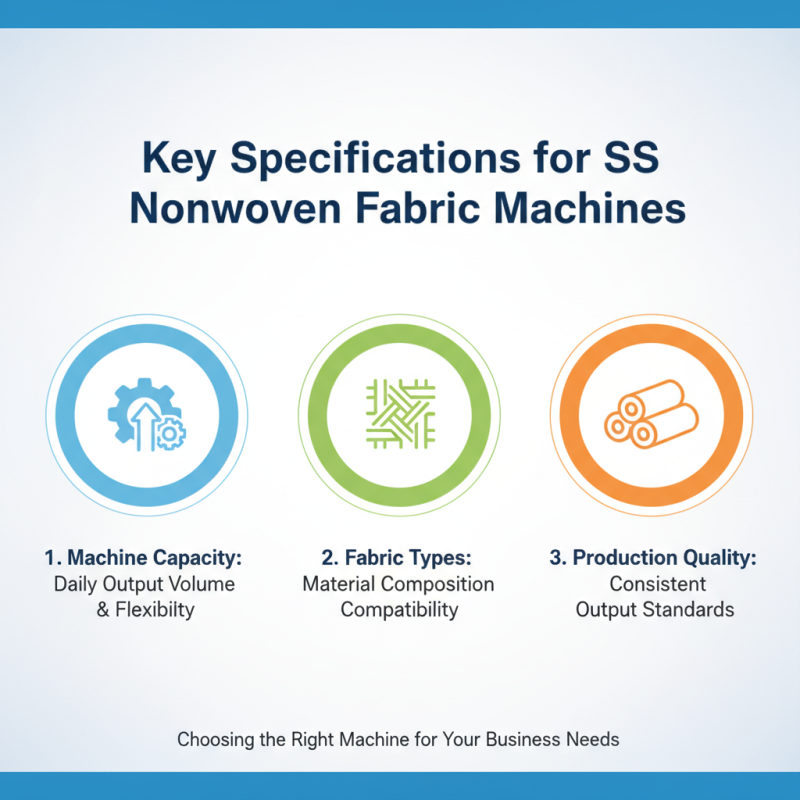
When selecting the right SS nonwoven fabric machine for your business, it's crucial to examine specific key specifications. Machine capacity is vital; determine how much output you need daily. Look for machines that can handle varying production volumes without compromising quality. Also, evaluate the types of nonwoven fabrics you intend to produce. Different machines cater to distinct fabric compositions, so choose one aligned with your material requirements.
Consider the energy efficiency of the machine. High energy costs can significantly impact your overall profits. Opt for machines designed for low energy consumption. They may have a higher upfront cost but will save money over time. Moreover, assess the maintenance needs. A machine requiring frequent repairs can disrupt production and elevate costs unexpectedly.
Tips: Always ask current users about their experiences. Practical insights help gauge long-term reliability. Confirm warranty coverage to protect your investment. Understanding the machine's versatility is equally important. Some machines perform multiple functions, enhancing their value in diverse applications. Reflect on your future goals too; choose a machine that grows with your business requirements.
Evaluating Production Capacity: Matching Machine Output to Business Needs
When evaluating production capacity, it's crucial to understand how a nonwoven fabric machine fits into your business framework. Different industries demand varied output levels. For instance, a packaging company may need higher volume production compared to a medical supply manufacturer. Identifying your specific needs helps in choosing the right machine.
Calculating your required capacity involves analyzing current orders and forecasting future demands. It's essential to think critically about potential market changes. You might realize that a machine with a slightly lower output may be more cost-effective in the long run. Production efficiency should not just focus on speed but also on the quality of materials produced.
Be mindful of the trade-offs involved. A machine with higher output may come with advanced features but can also lead to increased maintenance costs. Assess your resources thoroughly. Sometimes, investing in a moderately priced machine can yield better results than going for the highest capacity option. Reflection on your unique needs will guide you to the best decision.
Cost-Benefit Analysis: Assessing Machine Investment vs. Long-Term Profits
When assessing the investment in SS nonwoven fabric machines, it’s crucial to conduct a thorough
cost-benefit analysis. Analysts suggest that
initial costs can vary significantly, with some machines priced around $50,000 and others
exceeding $200,000. This stark difference often reflects the technology and efficiency of the
machine. A machine with higher upfront costs may deliver greater long-term savings through improved
production speeds and reduced waste.
According to recent industry reports, companies have documented up to a 25% increase in
production efficiency with high-quality machines. This boost translates into higher profit margins over time.
However, businesses must consider operational costs too. Maintenance and energy use can add up, potentially
offsetting initial savings. If not properly managed, these expenses may erode profitability. Many firms
fail to factor in all hidden costs, which can turn an ideal investment into a regrettable choice.
Ultimately, businesses must weigh the benefits of advanced technology
against potential risks. The right machine can drive growth, but overcommitting to an expensive option
without careful analysis can lead to financial strain. Continuous evaluation
of production needs is essential. What works today might not meet future demands. This ongoing
assessment is key to maintaining profitability in a fast-evolving market.